
Comprehensive internet marketing is a collection of digital marketing activities aimed at the holistic promotion and development of a business online. Promoting a website across the web can be achieved through various methods, as there are multiple approaches to marketing, each yielding results. However, it's impossible to choose just one that will be 100% effective in every case. What guarantees customer engagement, increased sales, brand recognition, and loyalty to your company are the services of comprehensive internet marketing.
Tools of Comprehensive Internet Marketing
- ⦿ SEO (Search Engine Optimization)
- ⦿ SERM (Search Engine Reputation Management)
- ⦿ SMM (Social Media Marketing)
- ⦿ Google Ads (Pay-Per-Click Advertising)
- ⦿ YouTube
- ⦿ Email, SMS, and Messenger Campaigns
A well-balanced combination and close interaction of these comprehensive internet marketing tools provide businesses with key advantages: effective traffic growth and increased sales.
SEO Promotion to the Top
Search Engine Optimization (SEO) is a set of actions aimed at improving a website's ranking in search engines. In other words, the goal of SEO optimization is to promote and advance the site in Google to attract targeted traffic. The primary objective is to move the site higher in search results for relevant queries.
Example of Organic (SEO) Google Search Results:
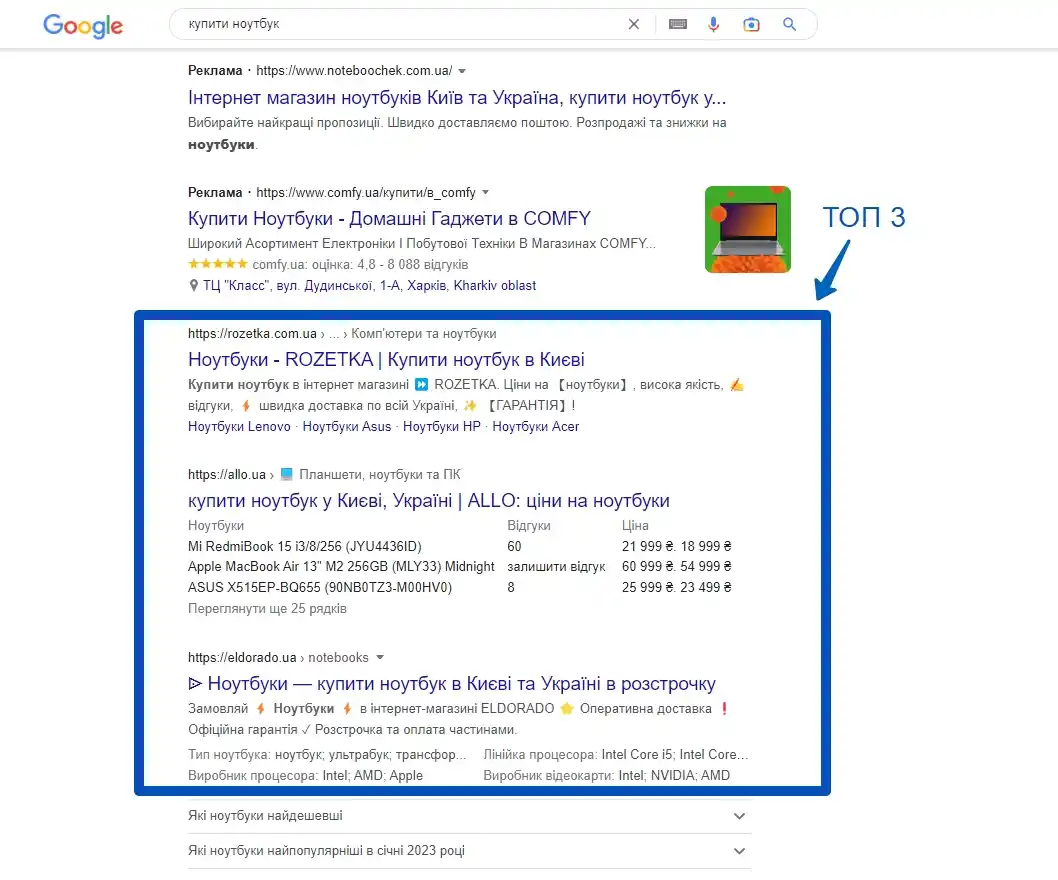
Search engines use specific algorithms to rank websites. The primary goal of search engines is to provide users with accurate answers to their queries.
Therefore, there are specific algorithms for ranking websites. The main task of an SEO specialist is to optimize the website so that it meets all the search engine criteria (over 200 factors) and aligns with user interests.
Key Factors for Ranking a Website in the Top
Textual Factors:
The content on your website’s pages should not only be unique and optimized for relevant search phrases (keywords) but also meaningful and informative. Search engines are capable of evaluating both text and graphic content on category pages, product cards, blog articles, and service pages for their usefulness to visitors.
When creating content, ask yourself: Does the text on the page answer all of the user’s questions? Does it fully cover the topic of the page? If your answer is "No," then it's time to work on your content!
Internal Factors (Technical Optimization):
Websites with slow page loading speeds on desktops or mobile devices, technical errors, or a lack of mobile responsiveness are unlikely to rank high, especially in competitive niches. One of the first things to check when analyzing a website for technical issues is the bounce rate in Google Analytics.
In our article Reasons for High Bounce Rates on Websites. How to Reduce Bounce Rates, we discuss in detail the technical issues that can negatively impact this metric.
External Signals:
Traffic coming from other websites (essentially, backlinks to your site that bring interested users to your resource). These referring websites, often called "donor sites," can have varying levels of authority in the eyes of the search engine, but all of them are valuable. In our next article, we’ll dive into the types of backlinks, their quality indicators, and ways to obtain them.
Behavioral Factors:
Search engines analyze user behavior on your site—how long visitors stay on specific pages, the depth of their engagement (how many pages they view), and how quickly they return to search results. If a user leaves your site after just a few seconds, it signals to search engines that your content wasn’t helpful, and the visitor didn’t find what they were looking for. These factors indicate how satisfied users are with your site. We also cover this topic in our article about the causes of high bounce rates.
With proper SEO promotion, you’re guaranteed to attract potential customers from search engines, leading to steady website traffic and increased conversions.
Pros and Cons of Search Engine Optimization (SEO)
Pros:
- Improved website usability
- Enhanced technical performance of the site
- The cost of promotion doesn’t depend on the number of visitors (unlike paid advertising)
Cons:
- Not suitable for every business
- No immediate results
- The optimization process is labor-intensive and requires time, as search engines also need time for indexing. Therefore, there is no fixed timeframe for results.
Google Ads – Contextual Advertising
Contextual advertising is a tool for displaying ads in search results that match the user's query and the content of your website. Ads are shown based on targeted keywords. For example, if you sell women's clothing, setting up Google Ads will focus on keywords that potential customers might search for, like "buy evening dress" or "buy women’s business suit." This ensures that your ad is shown to users who are actively looking to buy women's clothing.
Google Ads is a convenient and non-intrusive way to attract buyers and boost sales. Google Ads is considered the most popular and widely used contextual advertising platform.
Types of Contextual Ads
In Organic Search:
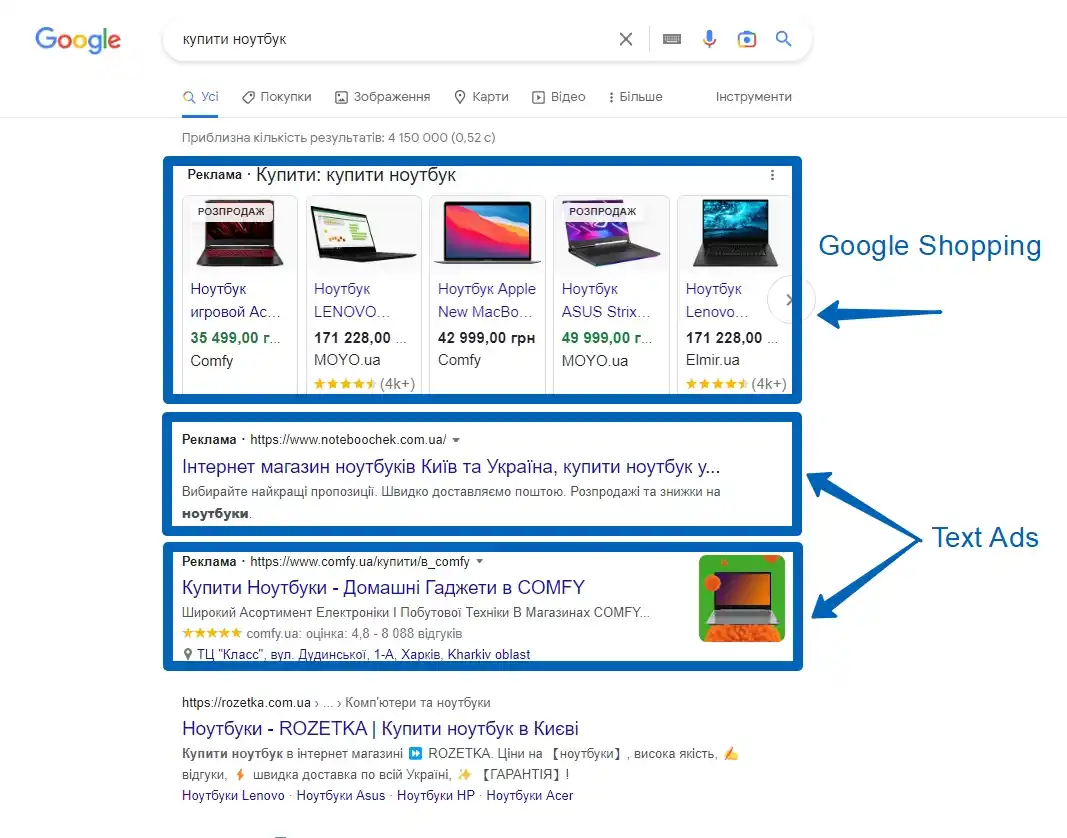
This type of Google Ads placement is considered the most effective since the ads resemble regular search results and closely match the user's query. They are displayed above organic search results (special placement block), below search results (guaranteed display block), or on the second or subsequent pages (dynamic display block). Google Ads is known for its user-friendly interface and provides numerous tools for creating effective advertising campaigns.
Example of Google Ads in Search Results:
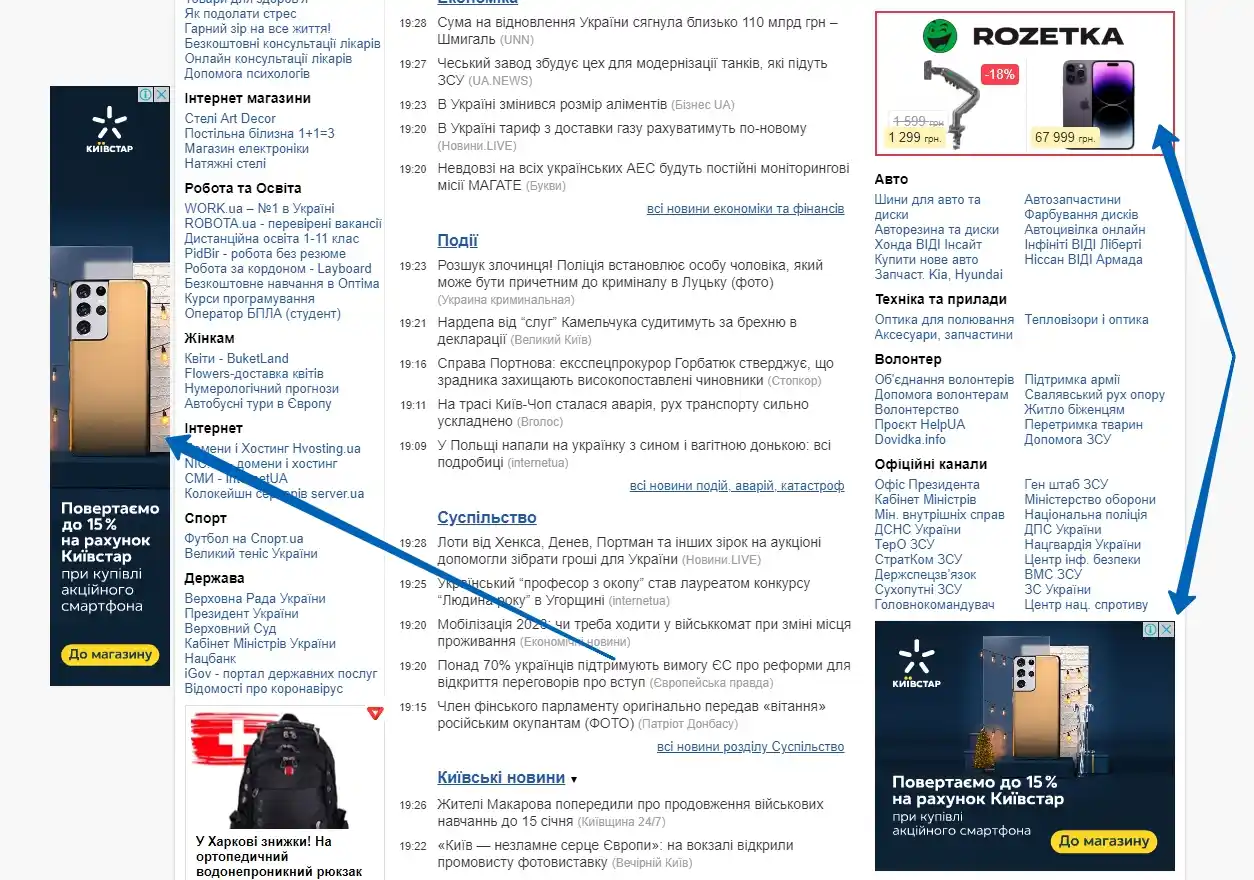
In the Contextual Display Network – ads are placed on websites that are part of the advertising system's partner network.
Let's consider ad placement in the Display Network (GDN):
Google Ads Technologies for Effective Ad Display
- Thematic Targeting – Analyzing website content;
- Behavioral Targeting – Analyzing search queries;
- Remarketing – Ads are shown to users who have visited the website but haven't made a purchase.
Advantages and Disadvantages of Contextual Advertising
Advantages:
- Quick results;
- Ability to control the budget and start with a minimal amount;
- Google Ads offers analytics and statistics;
- Specific targeting to your audience.
Disadvantages:
- Not suitable for every business;
- Requires constant financial investment;
- Potential for inefficient spending with incorrect settings.
Combine SEO and Contextual Advertising!
These internet marketing strategies are not identical, and it's impossible to say which is better. Both are relevant and effective. SEO optimization takes time but provides long-term results, while contextual advertising offers quick but short-lived results (it stops working once the financial investment ceases, unlike SEO).
It's not necessary to choose one over the other, especially when you can use them in parallel for a double benefit. The best option is to combine both for a comprehensive internet marketing strategy, which is what we're discussing today.
Social Media Marketing (SMM, Targeting)
Social media is an additional source of customers and profit for businesses. Competition? Yes. Demand? Always there. For these platforms, we have a specific marketing direction – SMM (promotion of goods and services on social networks).
Instagram remains the main and preferred platform for brands.
Simply registering your brand on trendy social networks isn't enough to find potential clients, let alone achieve a surge in sales.
We've previously explained how to create an Instagram page from scratch and attract followers in our article: How to Gain Instagram Followers for Free and Without Cheats in 2023.
SMM offers various methods to promote your page and attract buyers. The most effective one is targeted advertising on social networks.
Targeted Advertising on Instagram, Facebook, LinkedIn
An effective tool to boost sales and find new customers. Targeted ads help identify your audience and attract interested users. Another advantage is the convenient interface for adjusting ads: you can make changes, track and analyze statistics both during and after the campaign. It's affordable, with flexible budgets (you can start small).
This type of advertising increases audience engagement, brand recognition, and creates a different customer environment. In search engines, we get potential (hot) clients who are already looking for us, and with ads, we help them find us faster, giving no chance to competitors. In social media, however, we are the ones engaging the audience and making ourselves known, but we do it in a way that compels the user to want our product or service, even if they weren't actively searching for it.
Email Marketing
A tried-and-true method of electronic marketing.
Email campaigns offer several advantages:
- Remind previous clients about your brand;
- Engage your audience with promotions, discounts, or new products;
- Retain customers by gathering feedback on service quality.
In a comprehensive internet marketing strategy, email marketing is a must. The key is not to overdo it and avoid spamming. Provide valuable and necessary information for both you and your client to see positive results.
In 2023, numerous services simplify email marketing for entrepreneurs. For beginners unfamiliar with ads, we recommend using such services to save time.
Video Marketing as a Business Promotion Tool
A great addition to a comprehensive marketing strategy. YouTube, with its large audience and traffic, is as effective as Google Ads. The YouTube platform, like a social network, provides additional promotional opportunities. Creating a channel is simple, analytics are robust, and video content also appears in Google search results.
To use videos via Google Ads, you need to link your YouTube channel to your advertising account, enabling your ads to run alongside your video content.
External Content Marketing
External content marketing involves placing your company's materials on other platforms (social networks, other accounts, thematic resources, etc.). While a personal blog on your website is crucial and valuable, you shouldn't stop there.
External content marketing focuses on:
- Increasing brand awareness;
- Boosting audience engagement;
- Improving SEO performance;
- Finding partners if needed.
Best content for publication on external platforms:
- Articles that mention your brand's utility;
- Case studies demonstrating your expertise;
- Articles about your product/services and advantages;
- Materials showcasing why your company should be chosen.
Additional benefits of external marketing include:
- Driving traffic to your website from external sources;
- Introducing your company to potential new clients.
Comprehensive Internet Marketing – Conclusion
Comprehensive marketing offers vast opportunities to elevate your brand and sales to the desired level. This approach guarantees success by combining multiple tools rather than relying on just one. It delivers quick results and allows you to manage your budget efficiently.
Comprehensive marketing helps increase user engagement, leading to more clients and guaranteed sales growth.
Remember, the ultimate goal of traffic in a business is to drive users to your company’s website. If you're just starting, the first step should be to develop a business website.
Intent Solutions is ready to provide a full range of services to grow your business online: from website development and launching ad campaigns to optimizing and automating any business processes.